

If you change after training, carry sneakers separately, or move between the gym and a short trip, the wrong bag creates a practical problem: shoes can crowd clean clothing, wet gear can dampen the main compartment, or the bag may not fit your locker. How to Choose a Gym Bag With Shoe Compartment comes down to matching storage layout and size to what you actually carry.
This guide compares four listed options for daily workouts, swimming, travel, and overnight use. It focuses on compartment separation, shoe fit, carrying methods, available space, and cleaning considerations, so you can also browse the broader Gym Bags category when you are ready to compare other styles.
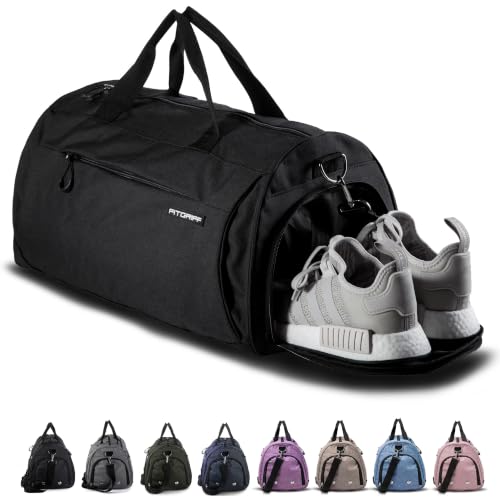
Pros
- Ventilated shoe compartment
- Waterproof wet pocket
- Six separate storage pockets
- Waterproof base
- Suitable for gym and travel
Cons
- Medium size may limit bulky gear
- Who should skip it: Shoppers needing a large equipment bag

Pros
- Lightweight 0.9-pound construction
- Dedicated ventilated shoe compartment
- Locker-friendly compact dimensions
- Detachable shoulder strap
- Structured frame support
Cons
- Small size limits bulky gear capacity
- No stated capacity or load limit
- Skip it if you need room for substantial equipment


1. Match the bag dimensions to your routine
Start with where the bag will be stored and what you normally pack. The Searock is listed at 14 by 8 by 10 inches, a compact footprint that may suit a standard locker or under-bench storage. The Fitgriff is listed at 23 by 12 by 12 inches in the medium size, giving you a larger stated exterior but potentially requiring more storage room.
The SOAEON measures 18.5 by 9.8 by 10.6 inches and lists a 30L capacity, while the MIYCOO listing describes a roomy main compartment but does not provide dimensions in the supplied data. Measure your locker, closet shelf, or travel space first. A larger bag can accommodate extra clothing and toiletries, but a compact bag is easier to store and less likely to become an awkward daily carry.
2. Check the shoe compartment against your footwear
A dedicated shoe pocket is useful only if it fits the shoes you actually wear. The supplied SOAEON listing specifically says its shoe compartment fits up to a men’s size 13 and includes two ventilation holes. Fitgriff describes its shoe pocket as ventilated, and Searock also lists a dedicated ventilated shoe compartment, but the supplied data does not state shoe-size limits for either model.
MIYCOO lists a separate shoe compartment without providing a stated shoe-size range. Compare the pocket opening and internal dimensions with your footwear, especially if you wear wide trainers, boots, or larger sizes. Also consider whether the shoes need to go in after a damp outdoor session, since ventilation and separation help organize the bag but do not replace drying shoes before storage.
3. Decide whether wet and dry separation is important
Swimmers, people who shower at the gym, and anyone carrying sweaty clothes should prioritize a separate wet pocket. Fitgriff lists an isolated waterproof wet pocket, while MIYCOO and SOAEON describe wet compartments with waterproof PVC lining. These designs can keep wet items apart from clean clothing, but they do not make the entire bag waterproof.
Searock’s supplied features describe water- and tear-resistant material with an interior PVC lining, but they do not list a dedicated wet pocket. If wet gear is part of your routine, verify that the compartment is large enough for your towel, swimwear, or clothing and plan to empty and air it after use. For general gym sessions without wet items, a simpler layout may be easier to pack and clean.
4. Compare carrying methods with your commute
Carrying style affects whether the bag works for a walk, public transit, or a short trip. Searock includes an adjustable, detachable shoulder strap and a padded top handle. Fitgriff lists a duffle-style design with multiple pockets, while SOAEON lists reinforced grip handles and a padded shoulder strap.
MIYCOO offers the broadest stated carrying flexibility: its shoulder straps can be hidden, and it can be used as a backpack, crossbody bag, or handbag. That versatility may be useful when your hands are full or when you switch between gym and travel use. The trade-off is that more carrying hardware and conversion points can make packing and adjustment more involved, so choose the method you will use most often rather than paying attention only to the number of options.
5. Evaluate organization versus open packing space
Pockets help separate keys, toiletries, electronics, bottles, and clothing, but every divider also changes how easily bulky items fit. Fitgriff lists six separate pockets, including a main compartment with a small inner pouch, a wet pocket, shoe pocket, front pocket, and side mesh pocket. SOAEON lists eight separate pockets, including interior zippered pockets, front pockets, bottle mesh pockets, a shoe compartment, and a wet pocket.
MIYCOO adds a zipper pocket and computer pocket within the main compartment, plus side zippered pockets that can hold one water bottle. That layout may suit someone who combines training with work or school. Searock keeps the stated layout simpler, with a main compartment, front pocket, side mesh pocket, and shoe compartment. Choose more organization if small items routinely disappear in your bag, or a simpler interior if you prefer quickly loading clothes and gear.
6. Consider material and cleaning access
The listings describe different material approaches, but none supplies a complete washing procedure. Fitgriff specifies sturdy exterior fabric and a waterproof base. Searock lists water- and tear-resistant fabric with a PVC-lined interior. MIYCOO uses upgraded canvas described as waterproof and wrinkle-resistant, and SOAEON uses water-resistant, tear-resistant polyester.
These descriptions support protection from light moisture or spills, not a claim that any bag is fully waterproof or machine washable. Before buying, check the care instructions and confirm that you can reach the bottom of the shoe and wet compartments. After use, remove damp items, wipe accessible lining, and leave the bag open to dry according to the manufacturer’s guidance.
How We Compared These Products
This comparison is based on the supplied product listings, including stated dimensions, capacity, materials, compartment layouts, carrying methods, and available feature descriptions. The supplied data does not document direct product use, so conclusions are conditional recommendations rather than claims about long-term durability, comfort, odor control, or real-world fit.
Which Option Fits Your Workout?
For a compact daily gym routine: Accessories for gym organization can include smaller carry options, and the Searock 14 inch Small Gym Bag with Shoe is the clearest fit from this group when locker or under-bench space is the priority. Its listed compact dimensions, frame support, shoe compartment, and detachable shoulder strap support that use case. Who should skip it: anyone who routinely carries several outfits, bulky footwear, or extensive wet gear should verify capacity carefully before choosing a mini duffle.
For swimming or sweaty clothing: the Fitgriff® Gym Bag for Men & Women with Shoe & Wet lists both an isolated waterproof wet pocket and a ventilated shoe pocket. The SOAEON option also lists wet and shoe separation, ventilation holes, and a 30L capacity, making it worth considering for people who pack multiple items. Who should skip either option: buyers who need a very small locker bag should compare the stated dimensions first, since these layouts may use more space than a minimalist duffle.
For gym-to-work or flexible travel carrying: the MIYCOO Gym Bag with Shoes Compartment, Duffle Bag lists backpack, crossbody, and handbag configurations, plus a computer pocket and wet compartment. It may suit a mixed commute where carrying style changes during the day. Who should skip it: anyone who needs a confirmed exterior size or shoe-size limit should verify those details before ordering because they are not included in the supplied information.
Frequently Asked Questions
Will a shoe compartment fit any men’s shoe size?
No. The SOAEON listing states that its shoe compartment fits up to a men’s size 13, but the supplied information does not provide shoe-size limits for the other three products. Check the seller’s current measurements if you wear large or wide shoes.
Does a wet pocket make a gym bag waterproof?
No. A waterproof-lined wet pocket is intended to separate damp items, while water-resistant fabric may help with light moisture. Neither description establishes that the entire bag is waterproof or suitable for submersion.
Which bag is easiest to store in a locker?
The Searock has the smallest stated dimensions at 14 by 8 by 10 inches and is specifically described as fitting under gym benches or inside standard lockers. Measure your own locker opening because internal dimensions vary.
Can I wash these gym bags in a washing machine?
The supplied listings do not confirm machine-washable construction for any of the four bags. Check each product’s care instructions, remove damp items promptly, and clean accessible surfaces according to the manufacturer’s guidance.
Which option has the most carrying flexibility?
MIYCOO lists three configurations: backpack, crossbody, and handbag. Searock lists a detachable shoulder strap and padded handle, while SOAEON lists handles and a padded shoulder strap. Compare these methods with how far you walk and whether you carry other items.
Are more pockets always better?
No. More pockets can make small items easier to sort, but dividers can reduce flexible space for bulky clothing or towels. Choose the layout that matches your packing list, then verify the dimensions of compartments used for shoes, bottles, and electronics.


Write Your Review
No reviews yet. Be the first to share your experience!