

A person choosing a treadmill for an apartment, home office, or compact gym has to balance two competing needs: a frame that stores easily and a deck that feels sufficiently stable for regular walking, jogging, or running. Choosing only by the highest incline or motor number can leave you with a belt that is too short, controls that do not match your routine, or a machine that is difficult to store.
This guide to Best Folding Incline Home Treadmills compares the listed belt sizes, incline systems, speed ranges, weight capacities, folding designs, displays, and app features. It also helps you decide whether you need automatic hill adjustments, a compact walking pad, a wider running surface, or a heavier frame. For broader equipment research, you can also browse the cardio equipment category.

Pros
- Foldable handle supports under-desk use
- 12 preset HIIT programs
- 350 lb stated weight capacity
- No assembly required
Cons
- Who should skip it: runners needing speeds above 7.5 mph

Pros
- 20% automatic incline
- Listed 450 lb capacity
- Foldable space-saving design
- Cushioned running deck
- Adjustable handlebars
Cons
- 41-inch belt may limit longer strides
- Assembly is required
- Who should skip it: shoppers needing a larger running surface

Pros
- 10 MPH maximum speed
- 0 to 10% incline range
- Folding frame for compact storage
- Adjustable cushioning for smoother strides
- Clear LCD workout display
Cons
- Many smart features require an iFIT membership
- Heart-rate monitor sold separately
- Who should skip it: buyers avoiding connected fitness subscriptions

Pros
- Compact folded storage profile
- Manual incline adjustment
- Six-point-two MPH maximum speed
- Twelve preset programs
- Supports users up to 220 lb
Cons
- Narrow 14.4-inch running area
- Maximum speed may not suit faster runners
- Who should skip it: users wanting a wider deck
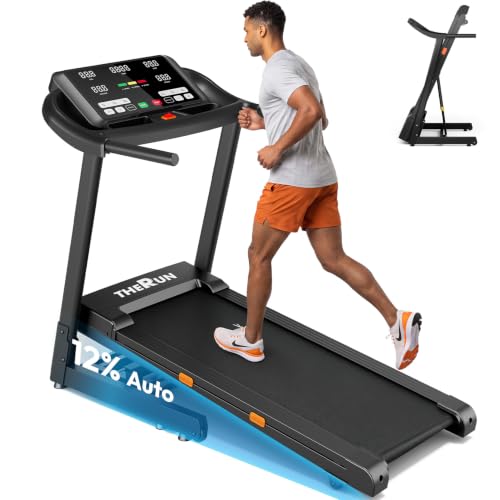
Pros
- 12-level auto incline
- 0.5 to 9 mph speed range
- Folding space-saving design
- 300 lb stated capacity
Cons
- Maximum speed is 9 mph
- Belt is 16.5 inches wide
- Who should skip it: users needing a higher speed or wider belt

Pros
- 15-level automatic incline
- Speeds up to 10 mph
- Foldable frame
- Bluetooth app connectivity
Cons
- Who should skip it: runners needing a longer-than-42.5-inch belt

Pros
- Advertised 400-lb user capacity
- 15-level automatic incline
- Folds for storage
- Safety handrail and stop key
- 95% pre-installed
Cons
- Grounded outlet required for operation
- 43-inch belt may feel short for some runners
- Who should skip it: Users needing a longer running surface

Pros
- Automatic incline up to 18%
- Stated 350 lb user capacity
- Foldable hydraulic design
- App and heart-rate tracking
- Shock-absorbing running belt
Cons
- 18-by-47-inch belt may feel short for taller runners
- Who should skip it: shoppers needing a longer running surface

Pros
- Folding handles and compact storage design
- Adjustable incline for varied walking
- Display tracks four workout metrics
Cons
- Top speed is suited to walking, not running
- Who should skip it: runners seeking running speeds

Pros
- Three incline levels up to 18%
- Three simultaneous workout displays
- Folding design with handrails
- 99% pre-assembled setup
- Listed 400 lb capacity
Cons
- Maximum speed is 7.5 MPH
- Who should skip it: users seeking faster running speeds
How to Choose Best Folding Incline Home Treadmills
Match the incline system to your workout
Incline type changes how quickly you can alter a workout. Automatic incline is useful for hill intervals or guided sessions because the machine can adjust through the console or supported app features. The WOFAQIE model specifies a 0 to 20% auto-incline range, while the MERACH model specifies an 18% auto incline and the WELLFIT model specifies 15 automatic levels. THERUN lists 0 to 12% automatic incline, and HUAGEED lists 15 automatic levels.
Manual incline can be adequate when you set one incline before walking and leave it there, but it is less convenient for frequent changes. The KALWOL model lists a 10% manual adjustment, the Vyrqenoxi model lists manual incline support feet, and the Viamotion model lists a 4-degree adjustable incline. LONTEK lists an 18% incline with three adjustable levels, so verify how those levels are selected before buying if precise hill intervals matter.
Check belt dimensions and intended activity
A belt that works for desk walking may feel restrictive during jogging. Among the listed options, HUAGEED and MERACH specify 18-inch-wide belts, with MERACH listing a 47-inch belt and HUAGEED listing a 42.5-inch belt. WELLFIT lists an 18 by 43 inch running surface, while THERUN lists 43.3 by 16.5 inches. WOFAQIE lists 41 by 16 inches, and KALWOL lists a 40 by 16 inch belt.
Compact models prioritize storage over stride room. Vyrqenoxi lists a 35 by 14.4 inch running area, and its maximum speed is 6.2 MPH. Viamotion lists a speed range up to 3.8 MPH, making it more clearly oriented toward walking. Before ordering, compare the listed belt length and width with your natural stride and intended pace, then allow clear space around the machine according to the manufacturer’s instructions.
Consider speed, motor descriptions, and capacity together
Speed range is a more direct clue to intended activity than a motor label alone. NordicTrack lists speeds up to 10 MPH, HUAGEED lists up to 10 MPH, THERUN up to 9 MPH, and MERACH up to 8.7 MPH. WELLFIT lists up to 8.8 MPH, while KALWOL and LONTEK list up to 7.5 MPH. The lower-speed Viamotion and Vyrqenoxi models are better matched to walking or light jogging than sustained faster running based on their listed ranges.
Capacity is a stated limit, not a guarantee of how every user will experience stability. The listings specify 450 lb for WOFAQIE, 400 lb for WELLFIT and LONTEK, 350 lb for KALWOL and MERACH, 300 lb for HUAGEED and THERUN, and 220 lb for Vyrqenoxi. Check the current manufacturer instructions, your own body weight, and whether the deck and handrails provide enough room for your activity.
Plan for folding, moving, and power
Folding does not mean a treadmill disappears. Measure the unfolded footprint, folded height, storage path, and the area needed to use the handrails before purchase. MERACH specifies hydraulic folding in 30 seconds, WELLFIT lists a soft-drop hydraulic system and a compact folded size, and NordicTrack describes assisted lowering. Vyrqenoxi, Viamotion, WOFAQIE, THERUN, and LONTEK also describe foldable or space-saving designs, but the supplied data does not establish that every model can fit under a particular bed or sofa.
Power planning matters in shared spaces. WELLFIT specifically states that it requires a grounded outlet. For every model, confirm outlet requirements, cord placement, floor protection, and whether the storage position leaves the cord safely out of the way. A treadmill that is awkward to move may stay unfolded, so transport wheels, folded dimensions, and the machine’s listed design are practical considerations rather than minor details.
Choose controls, display, and connectivity you will actually use
Simple controls can be preferable for repeat walking sessions, while app support may appeal to people who want workout data or interactive classes. NordicTrack lists iFIT compatibility, SmartAdjust, and ActivePulse features that require an iFIT Train Membership and, for heart-rate control, a compatible monitor sold separately. KALWOL lists FITSHOW, KINOMAP, and ZWIFT compatibility, plus a built-in speaker. MERACH lists a free MERACH app, LED workout data, and heart-rate display.
The remaining models emphasize onboard controls and displays. Vyrqenoxi and LONTEK list preset programs and countdown modes, while KALWOL lists 12 HIIT programs. These settings add convenience, but more programs do not automatically make a workout more useful. Verify phone compatibility, subscription requirements, display visibility, remote-control storage, and whether incline changes can be made without interrupting your stride.
How We Compared These Products
We compared the supplied product research, including stated belt dimensions, speed and incline ranges, weight capacities, folding features, cushioning descriptions, displays, app compatibility, and power notes. We also considered the available listing ratings, but the supplied product data does not provide customer review narratives or direct performance measurements. The recommendations below are therefore based on published specifications and practical fit, not firsthand use. For more information about the site’s approach, see the editorial research method.
Which Option Fits Your Workout?
For frequent incline walking or hill-focused sessions: 20% Auto Incline Treadmills for Home offers the highest listed automatic incline range, along with a 450 lb stated capacity and a 41 by 16 inch belt. Its trade-off is that the supplied data does not identify a companion training app. Who should skip it: someone who needs a verified longer belt or prefers a lower-profile under-desk design.
For a wider running surface and automatic incline: MERACH Treadmill with 15/18% Auto Incline lists an 18 by 47 inch belt, 18% auto incline, app support, and a 350 lb capacity. Its trade-off is a listed top speed of 8.7 MPH, which may not suit faster runners. Who should skip it: someone who wants a 10 MPH ceiling or does not plan to use app-based features.
For a small office or walking-first setup: Walking Pad Treadmill for Home lists a 0.6 to 3.8 MPH range, folding handles, a 4-degree adjustable incline, and storage of less than 0.5 square meters. Its trade-off is limited speed for running. Who should skip it: anyone planning regular jogging or faster treadmill intervals.
For a traditional compact treadmill with guided-workout options: NordicTrack T Series 6.5 S Treadmill lists 0 to 10 MPH speed, 0 to 10% incline, KeyFlex cushioning, folding storage, and iFIT features. Its trade-off is that several smart features require a membership, and the supplied data does not state the belt dimensions. Who should skip it: a buyer who wants a higher incline than 10% or does not want subscription-dependent features.
Frequently Asked Questions
Are folding incline treadmills suitable for running?
Some are. Models listing speeds of 8.7 to 10 MPH, such as MERACH, THERUN, HUAGEED, and NordicTrack, are more aligned with running than models topping out at 3.8 or 6.2 MPH. Belt length, width, handrail position, and your stride still determine whether a model feels appropriate.
Is automatic incline better than manual incline?
Automatic incline is more convenient for changing intensity during a session. Manual incline can be sufficient if you normally select one setting before starting. Compare the adjustment range and control method with your workout plan rather than assuming one system is universally better.
How much space should I leave around a treadmill?
Use the manufacturer’s clearance and safety instructions, then measure both the operating and folded positions. Keep the path to storage clear, and do not assume a folded frame can safely slide under furniture unless the folded dimensions and instructions support that placement.
Can I use these treadmills under a desk?
Do not assume every folding treadmill is designed for under-desk use. KALWOL specifically describes use under a table without handrails, while Viamotion is presented as an under-desk walking pad. Check the intended configuration, speed controls, and clearance before using any model with a desk.
What should I clean on a home treadmill?
Follow the manufacturer’s care instructions. In general, keep the belt and surrounding surfaces free of dust and sweat, use only approved cleaning products, and avoid putting liquid near electrical components. The supplied listings do not specify that any of these treadmills is fully washable.
Do app features require a subscription?
NordicTrack states that iFIT Train Membership is required for its iFIT features. KALWOL lists compatibility with FITSHOW, KINOMAP, and ZWIFT, while MERACH lists its free MERACH app. Confirm current app terms, phone compatibility, and any optional paid features before ordering.
What safety details should I verify?
Use the safety key and handrails as directed, place the treadmill on a suitable level surface, and follow the manual’s clearance and electrical requirements. WELLFIT specifically calls for a grounded outlet. Stop using a machine if its belt, controls, or power connection behaves unexpectedly and consult the manufacturer.




Write Your Review
No reviews yet. Be the first to share your experience!