

If you practice yoga in a small room, carry props to class, or want firmer support for stretching and Pilates, the wrong block can be frustrating. A thick cork block may offer more height and a grounded feel, while a lighter foam option can be easier to carry and clean.
This guide compares 10 options by material, dimensions, quantity, grip design, included accessories, storage practicality, and stated care information. It is intended to help you decide whether high-density cork suits your routine, or whether EVA foam is the more practical choice.

Pros
- Extra-thick 4-inch design
- Dense, firm cork construction
- Two-block set includes strap
- Suitable for multiple practices
- Listed warranty and guarantee
Cons
- Heavier than many foam alternatives
- Firm cork offers limited cushioning
- Who should skip it: shoppers seeking lightweight foam blocks

Pros
- Extra-thick 4-inch height
- Firm, non-slip cork surface
- Includes yoga strap
- Supports multiple workout styles
- One-year manufacturer warranty
Cons
- 5.29-pound set may be less portable
- Who should skip it: shoppers prioritizing minimal carry weight

Pros
- Two blocks included
- Slip-resistant surface
- Rounded, comfortable edges
- Soap-and-water cleaning
Cons
- Who should skip it: shoppers needing another size or material
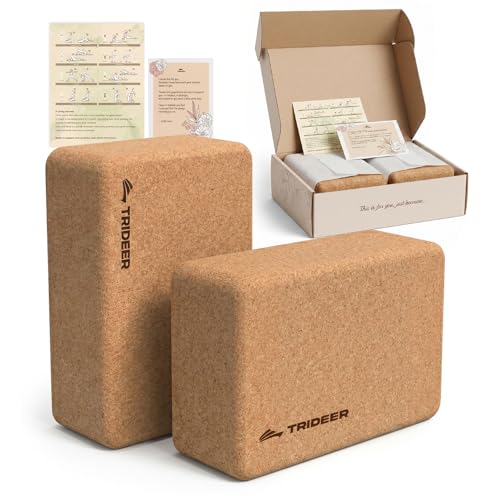
Pros
- Firm, high-density cork support
- Textured, contoured gripping surfaces
- Useful across several practices
- Two-block set for balanced positioning
- Includes an illustrated exercise guide
Cons
- Less cushioned than foam blocks
- Larger size may require more storage space
- Who should skip it: Users seeking soft, highly cushioned blocks

Pros
- Four blocks included
- Textured cork surface
- Wider profile for support
- Versatile yoga and Pilates use
Cons
- Hard cork offers less cushioning
- Who should skip it: Anyone seeking soft foam support

Pros
- Four cork blocks included
- Textured surfaces and wavy corners
- Two long straps included
- Useful across yoga, Pilates, and stretching
Cons
- Set weighs 10 pounds
- Who should skip it: shoppers seeking a lighter set

Pros
- Lightweight EVA foam construction
- Textured slip-resistant surface
- Two-block set for balanced support
- Recyclable material claim
- Resists deformation according to the manufacturer
Cons
- 2.95-inch height may not suit thicker-block preferences
- Who should skip it: users wanting thicker blocks
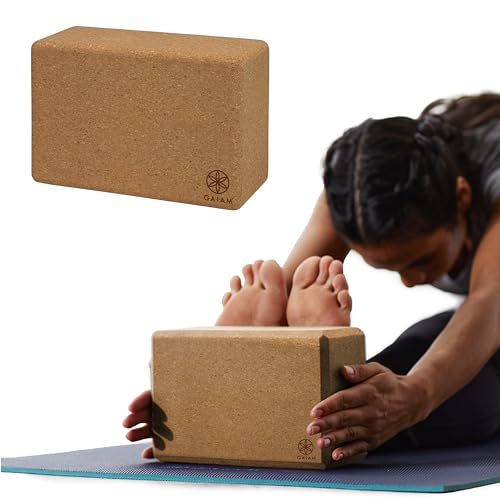
Pros
- Cork construction
- Rounded edges
- Suitable for several practices
- Compact 4 x 6 x 9-inch format
Cons
- Who should skip it: Shoppers specifically seeking an EVA foam block

Pros
- Two blocks included
- Textured grip surface
- Supports yoga, Pilates, and meditation
- Illustrated exercise guide included
Cons
- May feel firmer than foam blocks
- Who should skip it: anyone seeking a softer, lighter block

Cork density, firmness, and surface feel
Cork is generally the choice for people who want a firm, grounded prop rather than a very light foam block. The Body By Yoga and Trideer listings describe high-density cork, textured or non-slip surfaces, and support for yoga, Pilates, stretching, meditation, and other fitness exercises. Leitee also describes hard cork construction with a textured surface and wavy corners.
Firmness can help when you want a stable hand, foot, or seated support, but it may feel less forgiving than EVA foam. If you prefer a softer contact surface or need to carry props frequently, compare the cork choices with the lightweight Fitvids, Gaiam, and KEEP foam designs. Surface grip is a stated feature, not a guarantee of stability on every floor, so consider your flooring and practice conditions.
Dimensions and useful height
Size changes how a block works in a pose and how easily it fits in storage. Body By Yoga lists its blocks as extra thick at 4 inches, while Trideer lists 9 x 6 x 3 inches. Leitee lists 9 x 6 x 4-inch blocks, and Fitvids lists each block at 9 x 6 x 4 inches.
A 4-inch dimension may be useful when you need more reach or a higher support position, but it can take more shelf or bag space than a thinner block. Before ordering, compare the listed dimensions with your mat bag, storage bin, and the positions where you normally place your hands, feet, or seat.
Quantity and included straps
Two blocks are a practical starting point for symmetrical poses and many home routines. The Leitee 4 Pcs Cork Yoga Blocks package provides four blocks, while the Leitee 6 Pcs Cork Yoga Blocks with Straps listing specifies four blocks and two 8.2-foot straps. Body By Yoga lists an optional strap version, so verify the selected variant before ordering.
More blocks can support setups that use several props at once, but they also require more storage. A strap can help with controlled stretching and alignment practice, but it does not replace checking whether the included accessory is part of the exact variant you choose.
Weight, portability, and storage
Portability matters if you move between home, a studio, and a gym. Fitvids lists a two-block high-density foam set designed for on-the-go use, while KEEP describes each EVA block as about 0.44 lb. Gaiam describes its block as lightweight at 1.5 lb, although its listing contains mixed material wording, so verify the current product page before relying on that specification.
The cork listings emphasize density and stability rather than a supplied block weight. For a small apartment or shared storage area, measure the available shelf or closet space and consider whether a two-pack is enough. For a dedicated yoga area, a four-block set may be more useful if you regularly build supported positions.
Cleaning and moisture considerations
Cleaning information differs across the listings. Fitvids specifically states that its foam blocks can be cleaned with soap and water. Body By Yoga describes its cork as odor-resistant and moisture-tolerant, but that is not the same as saying the blocks are fully washable or waterproof.
If you practice hot yoga or sweat heavily, prioritize a surface and care routine you can maintain. Follow the manufacturer’s instructions, avoid assuming that moisture tolerance permits soaking, and allow props to dry appropriately before storage. For the other cork and EVA products, check the current care guidance because the supplied descriptions do not establish a complete cleaning method.
How We Compared These Products
We compared the supplied product specifications and listing claims, including materials, dimensions, quantities, surface design, portability, included straps, and stated cleaning information. Available customer ratings were treated as listing information rather than independent proof of performance. This guide is based on product research and does not claim direct product use.
Which Option Fits Your Workout?
For a firm two-block cork setup: Yoga equipment shoppers who want extra-thick support can consider Cork Yoga Blocks 2 Pack. The listing specifies 4-inch thickness, high-density cork, a non-slip surface, and an optional strap. Pros include the thicker support and stated chip-resistant cork composition. Cons are that the listing does not provide a block weight, and the strap depends on the selected variant. Who should skip it: shoppers who need the lightest possible props or want a fully documented wash routine.
For several users or prop-heavy routines: Yoga equipment buyers can consider Leitee 4 Pcs Cork Yoga Blocks. Its listed 9 x 6 x 4-inch size, four-block quantity, textured surface, and wavy corners may suit routines that use multiple supports. Pros include the larger set and stated grip features. Cons are the greater storage requirement compared with a two-pack and the absence of supplied weight or detailed cleaning instructions. Who should skip it: people with limited storage who only need a pair.
For portable, lower-weight foam support: consider Yoga Block, High Density EVA Foam Blocks for Yoga or Fitvids Set of 2 High Density Yoga Blocks. KEEP lists approximately 0.44 lb per block, while Fitvids specifies a two-block set, rounded edges, moisture-proof construction, and soap-and-water cleaning. Pros include easier handling and clear portability or care claims. Cons are that these are foam alternatives, not cork, and the listings do not establish identical firmness to the cork products. Who should skip them: shoppers specifically seeking the dense, natural cork feel.
Frequently Asked Questions
Are cork yoga blocks firmer than foam blocks?
The supplied listings describe the cork products as high-density or hard and the EVA products as lightweight foam. That supports a general material distinction, but firmness can vary by construction. Check the specific listing if the feel is important to your practice.
Is a 3-inch or 4-inch block better?
A 4-inch block offers a different height than a 3-inch block and may provide more reach in supported positions. A 3-inch block can take less space. Choose based on the height you need and verify the orientation and full dimensions before buying.
Do all of these products include a yoga strap?
No. The Leitee six-piece listing specifies two straps, and Body By Yoga lists an optional strap version. The other supplied product descriptions do not establish that a strap is included, so check the exact variant.
Can I wash cork yoga blocks with soap and water?
Do not assume that all cork blocks are washable. Fitvids specifically states soap-and-water cleaning for its foam blocks, while Body By Yoga describes cork as moisture-tolerant. Follow the care instructions for the selected product and avoid treating moisture tolerance as waterproofing.
Are two blocks enough for home yoga?
Two blocks can cover many common support needs, especially symmetrical positions. A four-block set may be more suitable if your routine regularly uses several props or if more than one person practices at the same time.
Which products are easiest to carry?
The supplied information points to the foam options for portability. Fitvids describes its blocks for on-the-go use, and KEEP lists each block at about 0.44 lb. The cork listings do not provide block weights, so compare the current package weight if carrying comfort is a priority.




Write Your Review
No reviews yet. Be the first to share your experience!