

A cyclist heading home after dusk has to choose between a compact visibility set for city streets and a brighter headlight for routes with little street lighting. A mismatched choice can mean carrying more light than the ride needs, or having too little information about runtime and weather resistance for the route. This guide to Best USB Rechargeable Bike Headlight and Taillight Sets compares the listed modes, charging details, mounting designs, and stated conditions so you can narrow the options to your riding routine.


Pros
- Front and rear lights included
- Multiple lighting modes
- USB rechargeable
- Compact and lightweight
- Aluminum-alloy construction
Cons
- Battery runtime is not specified
- Mounting compatibility is not specified
- Who should skip it: riders needing submersion protection
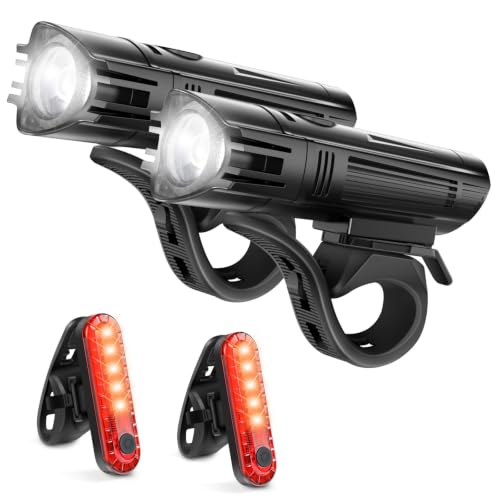


Pros
- Multiple front and rear lighting modes
- USB-C rechargeable
- Tool-free quick-release installation
- Taillight supports several mounting uses
Cons
- Advertised battery life varies by mode
- Brightness is not independently verified
- Who should skip it: riders who require verified output or runtime

Pros
- Front and rear lights included
- Multiple steady and flashing modes
- Tool-free installation
- Detachable for portable use
Cons
- Battery runtime is not specified
- Brightness figures are not specified


Pros
- Includes front headlight and taillight
- USB-C rechargeable design
- Aluminum alloy housing
- Tool-free installation
- Multiple listed vehicle applications
Cons
- High-beam runtime is listed at 1.5 to 2.5 hours
- Bracket fits only 20 to 30 mm stems
- Skip it if your vehicle falls outside listed compatibility
How to Choose Best USB Rechargeable Bike Headlight and Taillight Sets
Match the beam and brightness details to your route
First decide whether the front light needs to help you see an unlit route or mainly help others notice you on streets with ambient lighting. The listing for the Ascher 1000 Lumens Super Bright Bike Lights specifies a 1000-lumen headlight and says it is intended for dark trails, poorly lit streets, and commutes. The Schwinn 300 Lumen USB Rechargeable Bike Light Set specifies a 300-lumen headlight and a 10-lumen taillight, with city and road riding at dawn or dusk in mind.
Those figures describe different products, not a guarantee of how much usable light reaches your particular road. Beam shape, mounting angle, and the lighting mode can also affect what suits a route. Check the listing for the light output and beam description you need, and aim a front light so it does not distract oncoming road users.
Compare runtime with your ride and charging routine
Runtime can matter more than the number of modes if you ride for long stretches or cannot recharge between trips. Ascher specifies front-light runtime of 7 to 15 hours and rear-light runtime of 6 to 12 hours, depending on mode. DARKBEAM lists up to 4 to 8 hours for its headlight and 3 to 10 hours for its rear light, also with different operating modes.
These are listing claims, and actual duration depends on the selected mode and conditions. Before buying, check whether the product uses USB-C, another USB connection, or a supplied cable, and confirm both lights can be charged with your available setup. The BV set lists a micro USB charging cable and shorter stated runtime ranges, so it may call for more frequent charging on longer or repeated rides.
Understand water-resistance ratings
Rain exposure is a practical differentiator, but water resistance does not mean a light can be submerged or used in every weather condition. The Ascher 1000-lumen set lists IP65, Victoper’s 2026 Upgraded 10 LED Bike Light lists IP65, and DARKBEAM lists IPX5. Other listings specify IPX4 or IP44, while the BLITZU description calls its set water-resistant for rain and splashes without giving a rating in the supplied details.
If you ride in wet conditions, compare the exact rating and care instructions on the current listing rather than treating all ratings as interchangeable. A rating is only one selection factor: check that charging ports and mounts are properly secured as directed, and do not infer submersion protection from a rain-resistance claim.
Choose useful modes, not just a high mode count
Steady modes can provide a consistent front beam, while flashing options can help make a rider noticeable in traffic or at dusk. The Victoper Bike Light, High Lumens Super Bright lists six front modes and four rear modes. Schwinn lists steady, flash, and burst settings, while the basic Ascher set lists four modes for both lights.
More settings are only useful if you can select them easily and they fit the ride. Consider whether you want a simple control scheme or more options for changing light conditions. Also check whether the listed modes apply to both front and rear lights; product descriptions do not always use the same mode names or configuration.
Check mounting, portability, and bike fit
Quick-release mounts make it easier to remove lights for charging or when leaving a bicycle parked, while a more substantial mount may suit a rider who values a fixed setup. Several listed sets describe tool-free installation. Victoper’s first set lists a total weight of 4 ounces, and the Ascher 1000-lumen set lists a 5.9-ounce headlight weight, so they are not directly comparable as complete-set weights.
Before ordering, check your handlebar and seat-post shape and diameter against the supplied mount details, especially if your bike has unusual tubing or limited mounting space. The 4PCS USB Rechargeable Bike Lights Set uses flexible silicone mounts, while the Ascher 1000-lumen headlight listing describes 360-degree horizontal adjustment. A removable light can also be carried indoors, but confirm the attachment method works with your own bike.
How We Compared These Products
This guide is based on product research using the supplied listings, including stated brightness, runtime, modes, charging connections, water-resistance information, materials, and mounting features. Product claims are attributed to their listings where relevant; no direct-use assessment or independently verified performance data was supplied. Customer feedback was not available in the provided product information, so recommendations focus on features and stated use cases.
For more about the site’s editorial research method, see the review-process page. The outdoor sports category may also help if you are comparing other riding or outdoor equipment.
Which Option Fits Your Ride?
For longer rides on dark routes: Consider the Ascher 1000 Lumens Super Bright Bike Lights only after confirming its mount suits your bike. Its listing specifies a 1000-lumen front light, Type-C charging, and longer stated runtime ranges than some alternatives. The stated headlight weight is 5.9 ounces, which may be a drawback if minimizing front-end weight is your priority. Who should skip it: riders who want the lightest possible setup or do not need a high-output headlight.
For a city or road commuter seeking side visibility: The Schwinn 300 Lumen USB Rechargeable Bike Light Set lists a side-lens design, three modes, and USB-C charging. Its stated output and city-focused description make it a candidate for dawn, dusk, and urban rides, but the supplied details do not give a runtime figure. Who should skip it: riders who need runtime information before deciding or prioritize a higher stated headlight output.
For riders who want varied front and rear patterns: The Victoper 2026 Upgraded 10 LED Bike Light lists eight front modes, nine rear modes, an aluminum-alloy construction, and an IP65 rating. Its listing also describes a 4-ounce total weight. Mode variety may suit riders who like to adjust visibility settings, but verify the specific control and runtime details before relying on it for a long ride. Who should skip it: riders who prefer a minimal control scheme or need clearly stated runtime for their chosen mode.
Frequently Asked Questions
Are USB-C and other USB charging connections interchangeable?
Not necessarily. Some products specify USB-C or Type-C, while the BV listing specifies a micro USB cable. Check the connector on both lights and confirm you have a compatible cable or charging source before purchase.
Will these lights fit any bicycle?
Listings describe mounts as suitable for common bicycle setups, but the supplied information does not give dimensions for every mount. Compare your handlebar and seat-post shape with the current product details, particularly if you use a nonstandard bike or accessories that occupy mounting space.
Can I use a flashing mode on every ride?
Products in this comparison include various flashing patterns, but the supplied data does not establish which mode is appropriate for every location or local rule. Check applicable local requirements and choose a setting that keeps you visible without creating an avoidable distraction for other road users.
Does an IP rating mean a light is waterproof?
No. The listed IP ratings describe resistance under defined conditions, but they do not make a product suitable for submersion or every environment. Follow the product’s care instructions and inspect the current listing for the exact rating.
How often will I need to recharge the lights?
It depends on the specific set and selected mode. Compare the stated front and rear runtimes separately, since they can differ, and allow for more frequent charging when using brighter steady settings if the listing indicates mode-dependent runtime.
Can the lights be removed for charging or storage?
Several listings describe quick-release or tool-free mounts, but the attachment details vary. Confirm the removal method for the exact model, and consider whether you want to take the lights with you when parking the bike.
For your final choice, prioritize the route, mode-specific runtime, charging connector, and mount fit. A bright headline figure alone does not establish how a light will work on your bike or in your riding conditions.




Write Your Review
No reviews yet. Be the first to share your experience!